 STUUBZZZ
MiniMax H3 on 8 GB VRAM: what an RTX 3060 Ti with 16 GB of RAM really takes
MiniMax H3 ran on an 8 GB RTX 3060 Ti with 16 GB of RAM: 5:17 per 6 s clip, no crash. Every render time, the settings that helped and the ones that did not.
Settings, measured timings and teardowns for self-hosted AI video in ComfyUI: MiniMax H3, LTX 2.5, the Stubelius workflows, LoRA training and character consistency. My own timings come from one RTX 5090, and each post says how it was tested and where a number is someone else's.
MiniMax H3 ran on an 8 GB RTX 3060 Ti with 16 GB of RAM: 5:17 per 6 s clip, no crash. Every render time, the settings that helped and the ones that did not.
Free AI influencer on an RTX 5090: MOSS edits kept her face in 7 of 10, MiniMax H3 talking clips took 2.5 min each, and plain-wall pictures fixed a scene jump.
A free AI character swap in ComfyUI with MiniMax H3 took about 6 minutes per 8-second clip on an RTX 5090 and kept the sound. See where hard cuts broke it.
Claude Code wrote scripts that cut my 88-second MiniMax H3 film in free FilmCraft over MCP: a 66 s scripted replay, 3 cropped 4K takes flagged, and what broke.
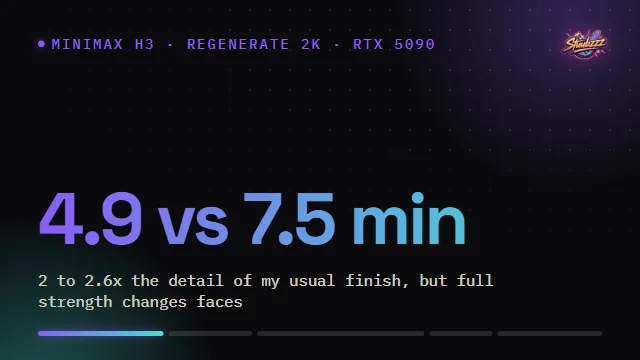
NVIDIA's Regenerate 2K gave MiniMax H3 clips in ComfyUI 2 to 2.6x the detail of a 1.5x H3 re-render plus RTX VSR, in 4.9 min not 7.5. Gentle changes faces less.

Six free local voice clones of my own voice, 84 takes on an RTX 5090: VoxCPM2 in VoiceStudio won with 10/12 word-perfect and a 0.962 match. Check licences.
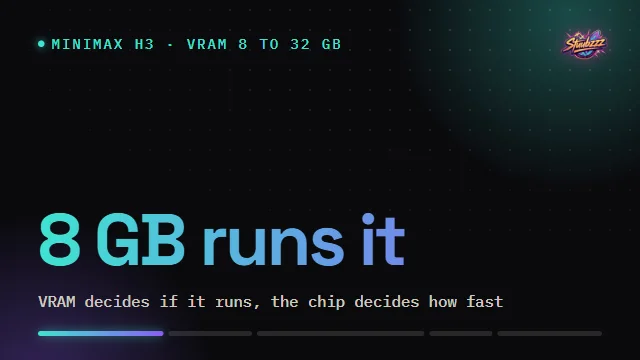
MiniMax H3, FLUX 3 Klein, Qwen-Image and VoxCPM2 all ran at 8 GB of VRAM; a 27B chat model jumped from 11 to 101 tokens/s at 12 GB. Every size measured.

RelayVSR 2x and NVIDIA's Regenerate 2K IC both kept MiniMax H3 faces at 0.96 to 0.97, but RelayVSR took 13 s per 5 s clip on an RTX 5090 and IC 2.5 minutes.
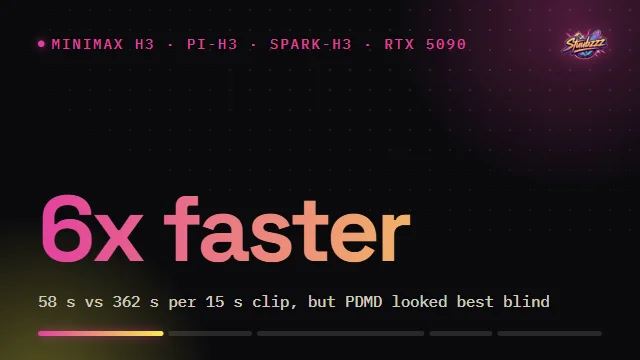
pi-H3 with Spark-H3 made a 15 s MiniMax H3 clip in 58 s on an RTX 5090, 6x faster than PDMD. Then I judged every take blind, and PDMD still looked best.

In 99 RTX 5090 clips, names hidden, Kandinsky 6 Pro won 5 of 10 rounds, LTX 2.5 three and H3 two. Pro took 201.6 s a clip, LTX 24.6 s, each at its own size.

Pika H3 Flex on MiniMax H3 in ComfyUI had the clearest sound of three fast routes to my ear, a small edge over 54 takes, at about 1.5x PDMD's time.

FastH3 Omni vs PDMD on MiniMax H3 in ComfyUI, 48 clips, RTX 5090: slower at 5 s (51 vs 39 s), faster at 15 s (157 vs 173 s). Without VSA: 1.8x PDMD's time.
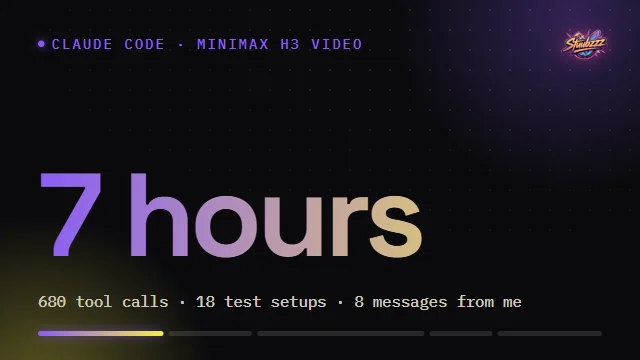
Claude Code ran ComfyUI and made my MiniMax H3 video in about 7 hours: 680 tool calls and 8 messages from me. What it did, what stayed mine, where it failed.
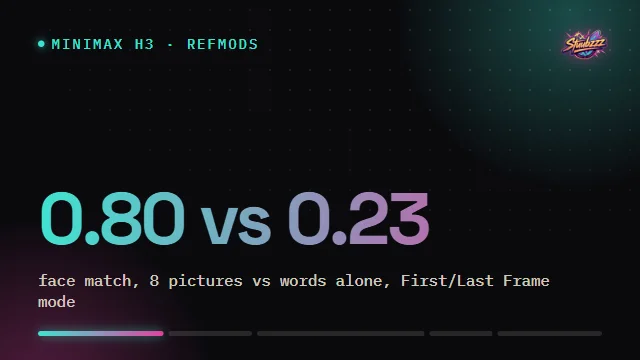
A MiniMax H3 RefMod from 8 pictures took face match from 0.23 to 0.80 in First/Last Frame mode. In Reference mode one good picture tied it, and rendered faster.
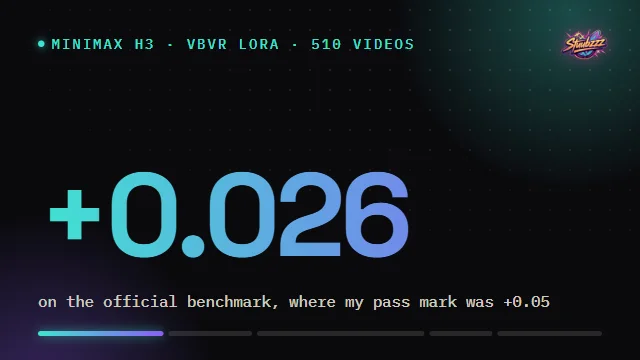
The VBVR reasoning LoRA moved MiniMax H3 from 0.272 to 0.298 on the official benchmark in my 510-video RTX 5090 test. See what a control showed was chance.

I trained a MiniMax H3 character LoRA in AI Toolkit on an RTX 5090: 29 clips, about 15 GPU hours, and on one seed I picked step 3,000 over the final file.

Ultimate H3 0.13 renders long MiniMax H3 videos in ComfyUI in chunks. On an RTX 5090, retaking chunk 2 of a 12 s Speed video took 54 s, both chunks 83 to 121 s.
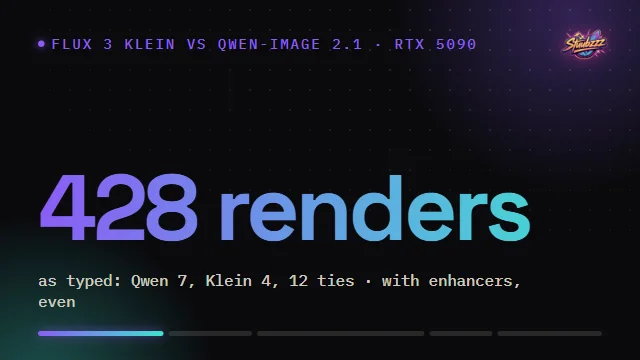
In 428 renders on an RTX 5090, prompts as typed, Qwen-Image 2.1 won 7 of 23 image types to FLUX 3 Klein's 4 (12 ties). Klein won short text, Qwen editing.
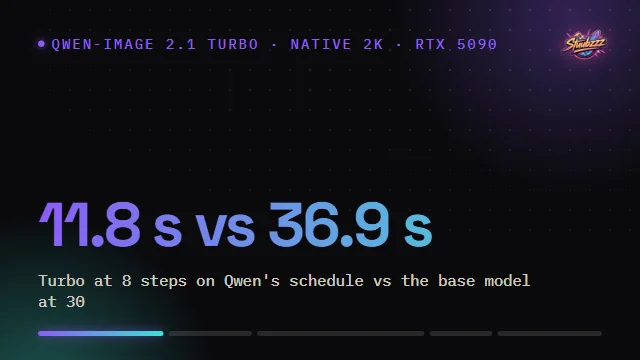
Qwen-Image 2.1 Turbo made a native 2K image in 11.8 s vs 36.9 s for the 30-step base model on an RTX 5090, and needs Qwen's 8-step sigma schedule in ComfyUI.
Ultimate H3 0.11 lets you direct MiniMax H3 in ComfyUI with up to two middle frames, a clip continued from its last 1.6 s, and up to 8 pinned sounds or clips.
The free Part 1 of ComfyUI From Zero covers eight errors beginners actually see, from Value not in list to CUDA out of memory: each message, meaning and fix.
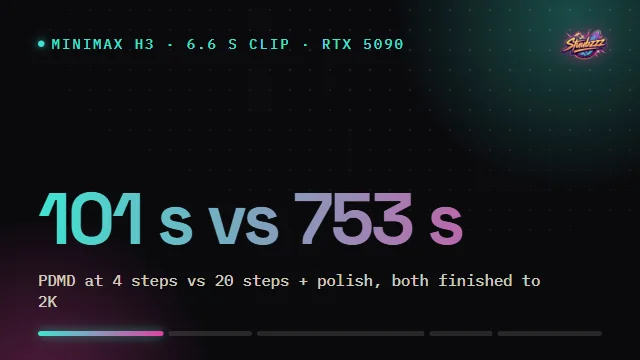
PDMD's 4-step LoRA finished a 6.6 s MiniMax H3 clip to 2520×1440 in 101 s on an RTX 5090, against 753 s for 20 steps plus polish. SoL Refiner changed faces.
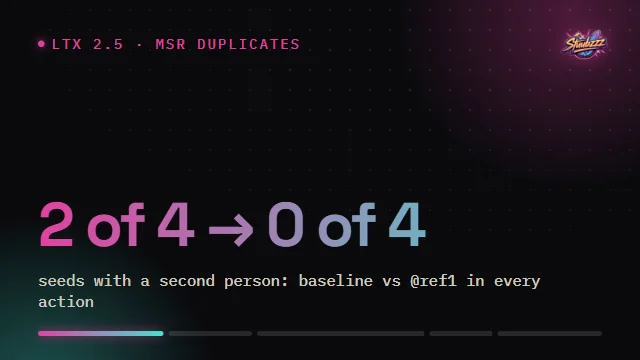
Each LTX 2.5 mode in ComfyUI wants its own prompt. With MSR V1, naming @ref1 in every action cut seeds with a duplicate character from 2 of 4 to 0 of 4.
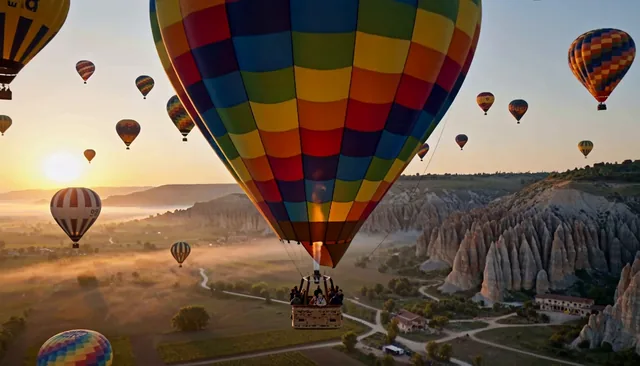
Stubelius Ultimate H3, a free MiniMax H3 workflow for ComfyUI: three presets, 8 s clip times and peak VRAM on an RTX 5090, seed hunting and install.

Soft LTX 2.5 video often comes from a half-size first pass. Same seed on an RTX 5090: 61.1 s at full size vs 46.2 s at 0.5 plus a x2 latent refine.
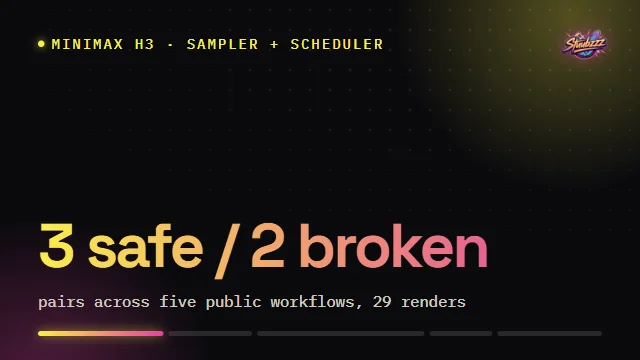
Five MiniMax H3 workflows at 6 to 14 steps: euler/simple, euler/beta and er_sde/beta had no gross failure. dpmpp_2m_sde/karras gave noise on four of five.
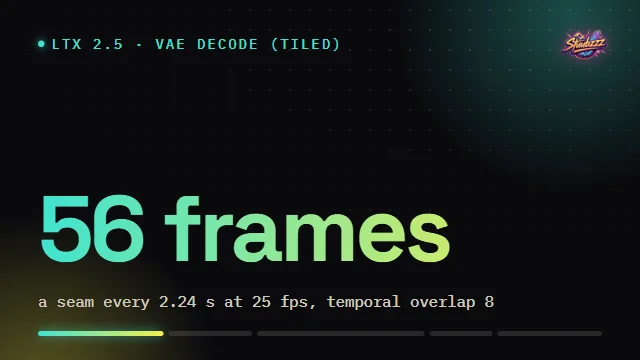
LTX 2.5 flickers every 56 frames when VAE Decode (Tiled) uses temporal overlap 8. On Windows an oversized decode spills into shared GPU memory. Two fixes.
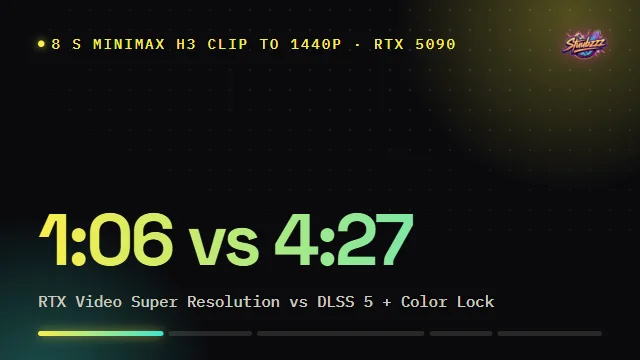
Upscaling an 8 s MiniMax H3 clip to 1440p in ComfyUI on an RTX 5090: RTX VSR 1:06, DLSS 5 + Color Lock 4:27. Plus LTX 2.5 times and the colour fix.
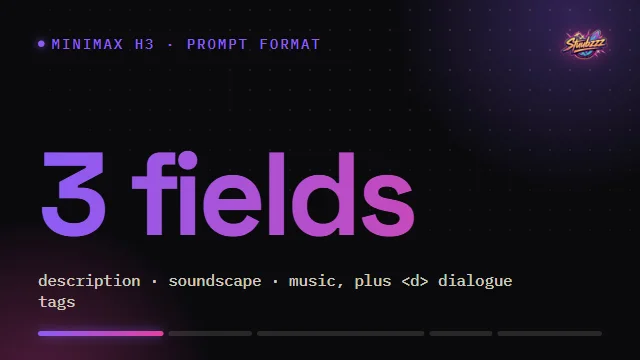
The structured prompt MiniMax H3 expects: alignment line, three named fields, (S1) speaker IDs, dialogue tags, shot timestamps and the 17k+5 frame grid.
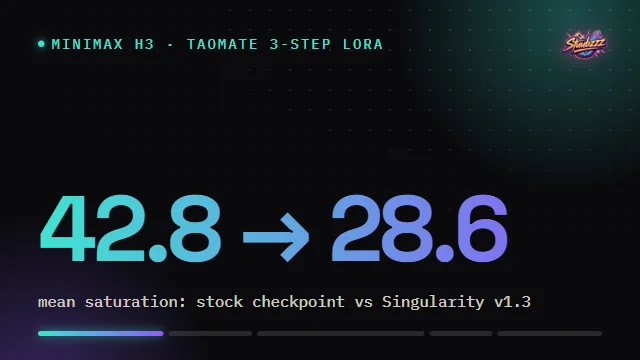
Eight MiniMax H3 runs on one seed: TaoMate 3-step on Singularity v1.3 drops saturation from 42.8 to 28.6. TaoMate on stock and turbo on both hold colour.

From the AI Toolkit code at commit ecee894: what Training Adapter and Contrastive Guidance set for MiniMax H3 LoRAs, and when Differential Guidance runs.

Free LTX 2.5 ComfyUI workflow: multi-shot timeline, 1 to 4 seeds with sound, Licon MSR references, up to 4K. Install steps and RTX 5090 timings.
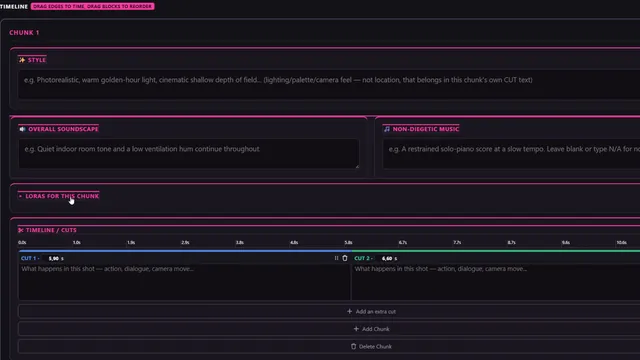
Stubelius Director for MiniMax H3 in ComfyUI: scout up to 4 seeds at 0.25 MP, finish one with a learned 2x latent upscale. Settings and install.
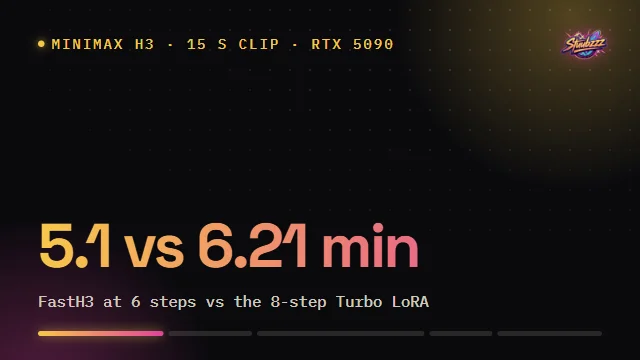
FastH3 preview adapter at 6 steps vs the 8-step Turbo LoRA on MiniMax H3: 5.1 vs 6.21 min (18% less) for a 15 s 1344×768 clip on an RTX 5090, one run each.
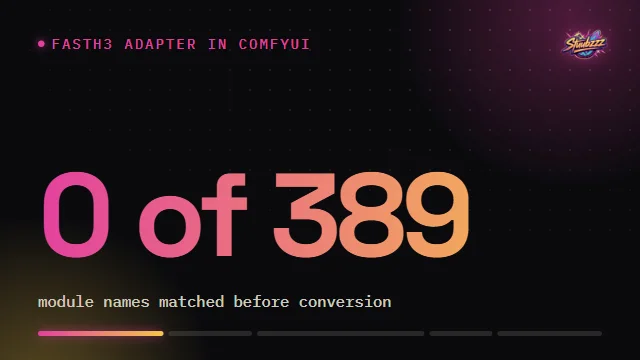
FastVideo's FastH3 preview adapter loads in ComfyUI and changes nothing: 0 of 389 module names match the pruned MiniMax H3. Key map, converter, settings.
LTX 2.5 distilled in ComfyUI: euler_ancestral + linear_quadratic at 8 steps, cfg 1, matches Lightricks' sigmas. Plus when the distilled LoRA is needed.

MiniMax H3 slides to flat anime or 3D. A style LoRA retrained on 50 three-second clips holds a glossy 2.5D look. Same-seed strength sweep from 0.4 to 1.0.

Consistent character LoRA training needs 15 to 30 images on five views in one outfit. See the sheet, the six rules and a tested Qwen-Image 2.1 character LoRA.
Learn it, fix it live, or have it made.
The ComfyUI From Zero course explains the machine from the first node to training your own LoRA, and Part 1 is free. If something is fighting you right now, bring it to a 60-minute 1-on-1.