STUUBZZZ
Claude Code and ComfyUI: how an AI agent made a MiniMax H3 video, from the session log
 Watch the video · I Let Claude Code Run ComfyUI and Make My Whole MiniMax H3 Video
Claude Code by Anthropic ran ComfyUI and made my 10:28 MiniMax H3 video in about 7 hours of session time on an RTX 5090: 680 tool calls and 8 typed messages from me up to the finished file (10 with the wrap-up). It ran the tests, narration and edit. The calls made by eye and ear stayed mine.
- Claude Code, running Claude Opus 5.5, made my MiniMax H3 RefMods video in about 7 hours on 2026-10-23 and 2026-10-24: about 1 hour of prep, then 6 h 8 min from my go to the finished 10:28 file.
- By its session log, with repeated lines removed, Claude Code made 680 tool calls on that MiniMax H3 video up to the finished file. I typed 8 messages in that time and 2 afterwards, 10 in all.
- On one RTX 5090, Claude Code ran 18 MiniMax H3 test setups on 3 seeds each in ComfyUI, scored every clip with face recognition, rewrote the script from the scores, made about 300 takes in my cloned voice and cut the video with ffmpeg.
- Claude Code ran this October 2026 ComfyUI batch without the ComfyUI MCP server: no call went through it. Python scripts it wrote posted each workflow to ComfyUI's API.
- In my use, Claude Code can't hear or watch motion. On earlier projects of mine, a slowed cloned voice passed all its checks and sounded robotic, and it missed a morphing leg in a take, so those stay a person's job.
What is Claude Code?
Claude Code is an AI agent from Anthropic that can run on your computer: you say what you want in plain English, and it writes code, runs programs, opens files, checks the result and fixes what's wrong. Its GitHub page calls it "an agentic coding tool that lives in your terminal".
Here it drove ComfyUI, a free, open-source program that runs image and video models on your own computer, to test MiniMax H3, MiniMax's video model with sound. The video it made is my test of RefMods against reference images; a RefMod is a set of pictures of one character, saved as one small file. That video had 3,419 views after about a day (vidIQ, 2026-10-25).
How long did Claude Code take to make a whole MiniMax H3 video?
About 7 hours of session time: 1 h 1 min of prep on 2026-10-23, then 6 h 8 min on 2026-10-24 from "Ok gpu is free" to the finished file. That covers 680 tool calls, but not all of it was the agent working: about 3 h 45 min of the second day was batch jobs running.
| Stage | When | Length | Tool calls | My messages |
|---|---|---|---|---|
| Prep: titles, script v1, test, voice and thumbnail code | 10-23, 03:22 to 04:23 | 1 h 1 min | 154 | 2 |
| Production: tests to finished file | 10-24, 13:07 to 19:15 | 6 h 8 min | 526 | 6 |
| Up to the finished file | Both sittings | about 7 h 9 min | 680 | 8 |
| Wrap-up: clean-up, README | 10-24, 19:44 to 19:59 | 15 min | 39 | 2 |
The batch jobs were the main test chain (13:10 to 15:03), the first 300 narration takes (5,285 s) and one extra test (17:06 to about 17:31). The table leaves out about 33 hours between the two sittings: a LoRA training of mine, and a failure I come back to below.
From the Claude Code session log and the run's chain.log. Renders on an RTX 5090 (32 GB), 96 GB RAM, Windows 11 (how I test).
What did Claude Code do on the MiniMax H3 video, step by step?
Claude Code worked through nine steps: plan, tests, script rewrite, voice, screen captures, edit, sound, captions and packaging. I set the direction, changed it in the middle and picked what went up. The table shows its part and mine at each step.
| Step | What Claude Code did | What stayed mine |
|---|---|---|
| 1. Plan | Researched demand, wrote script v1 (1,284 words), recommended a new character | The topic; approving the plan |
| 2. Tests | Made the character with Qwen-Image 2.1 by Qwen, built the RefMods, queued 18 setups on 3 seeds each, scored every clip with face recognition | The GPU go; yes to one extra test |
| 3. Script again | Rewrote the script from the scores and listed every claim that changed | Checking that list |
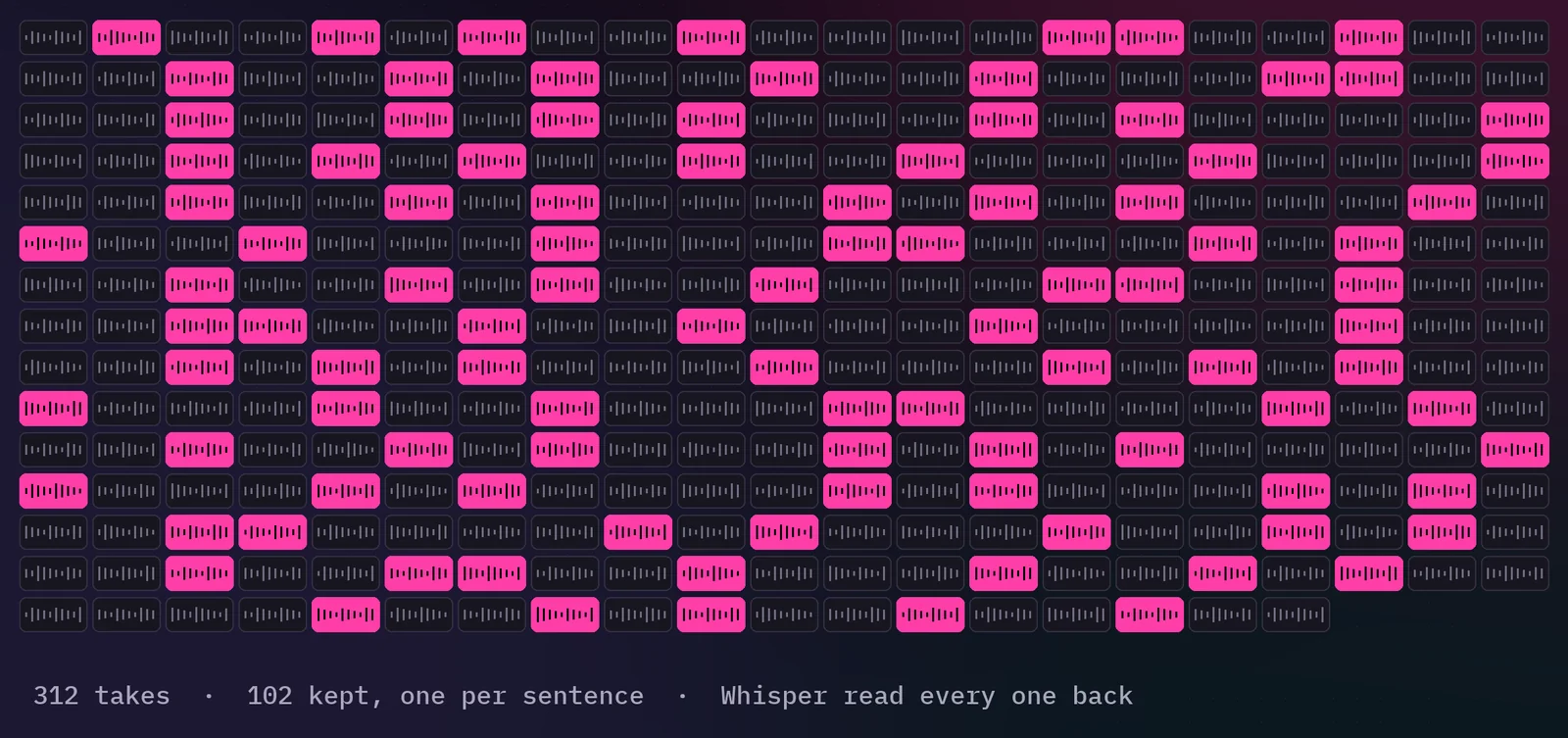
| 4. Voice | Made every sentence on 3 seeds, had Whisper read each take back, kept the one matching the script: 312 takes, 102 kept | Asking for an AI voice |
| 5. Screens | Drove the workflow windows in headless Chrome and captured them | Nothing typed |
| 6. Edit | Planned cuts on word times, rendered cards from code in my brand colours, built every shot | Nothing typed |
| 7. Sound | Clip sound 22 dB under the voice; measured -14.7 LUFS, -1.7 dBFS peak | Nothing typed |
| 8. Captions | 145 cues in the script's own words, plus chapters, with names Whisper mishears fixed ("config UI" for ComfyUI) | Nothing typed |
| 9. Packaging | Scored titles with vidIQ, built thumbnails from real frames, wrote the description, tags and pinned comment | Redirecting the thumbnail; picking it and the titles; the upload |
The first script came before the tests, and parts of it didn't survive them: the character's own footage scored 0.85, not 0.74; "louder with the character" was removed; the RefMod's slowdown in PDMD mode went from +3% to +13%.
What stayed my call when the agent made the video?
The topic, the go for the GPU, the thumbnail direction, one extra test, the title pick and the upload stayed mine. I typed 10 messages for the RefMods video, all listed below. The video says I made maybe 8 decisions during production; the log shows they came in 6 messages.
| When | What I typed | What it settled |
|---|---|---|
| 10-23 03:22 | "prep the refmod video, this one will be ai voiced" | Topic, AI voice |
| 10-23 03:59 | "go with your recommendations, start after the training" | Plan, character, script v1 |
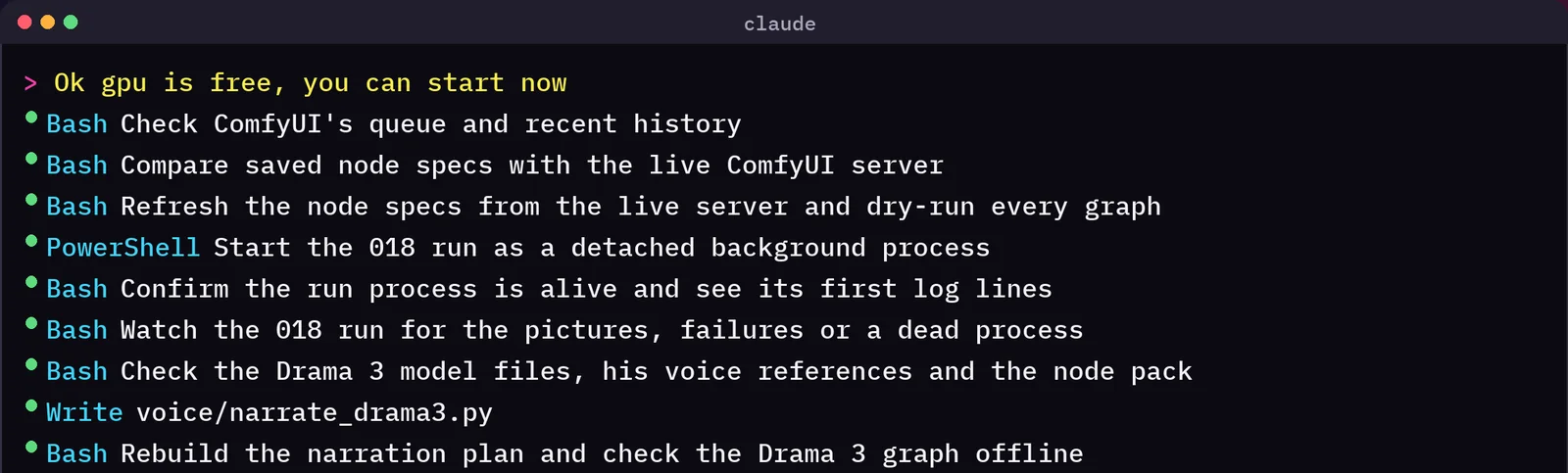
| 10-24 13:07 | "Ok gpu is free, you can start now" | The go |
| 10-24 15:35 | A note: mentioning pictures reads as basic, so RefMods vs reference images | Thumbnail angle |
| 10-24 15:56 | "versus, and yes run the test", plus two points for the script | Thumbnail, one more test, two script points |
| 10-24 16:38 | "yes, draft some RefMods titles" | New titles |
| 10-24 18:30 | "What were the title options? I lost it in this long chat" | Nothing |
| 10-24 18:33 | "go with A, B and C. Three titles for testing" | The titles |
| 10-24 19:44 | "yes, clean up the leftovers" | Clean-up |
| 10-24 19:54 | "update the README with the fisherman numbers. Video uploaded" | README; the upload was mine |
Does Claude Code need the ComfyUI MCP server to run ComfyUI?
No, not for this run. The setup in the video has Comfy Org's free ComfyUI MCP server between the agent and ComfyUI, but the session log shows no call through a ComfyUI MCP tool. Python scripts the agent wrote posted each workflow to ComfyUI's HTTP API at /prompt.
The ComfyUI MCP server is a free Comfy Org tool that lets an agent queue a workflow, wait for it and fetch the result. It's the route the video's description links. The long batch went another way:
- The scripts load Stubelius Ultimate H3 as an API graph and change it for each test.
- The agent compared the saved node specs with the live server and dry-ran every graph first.
- It started the run as a detached background process writing to
chain.log, withPAUSEandSTOPflag files, then kept checking for failures or a dead process.
I did not compare the two routes, so I can't say one is better.
Which tools did Claude Code use to edit the video?
ffmpeg did the cutting, Whisper the listening and ComfyUI the rendering, with Python tying them together and Fish Audio Drama 3 making my cloned voice. Of the 680 tool calls, 396 were shell commands, 121 file reads and 92 file writes or edits.
| Tool | Its job in this run |
|---|---|
| ComfyUI, Ultimate H3 | Tests and finished clips; RefMods with ComfyUI-MiniMaxH3Mod by Luisacaotica |
| Fish Audio Drama 3 | Narration, 5,285 s for the first 300 takes |
| Whisper (faster-whisper) | Word times and read-back, on the CPU |
| ArcFace in InsightFace | The face-match score |
| ffmpeg | Cuts, the mix, loudness measurement, the final join |
| Remotion | The channel's call-to-action graphics only |
| vidIQ | 19 title scores |
| DaVinci Resolve | Not used here: the agent can write a timeline for its free version, but this edit went straight to a file |
Where did Claude Code go wrong on video work?
On my projects, Claude Code goes wrong on anything you have to hear or watch in motion, because it reads instead: the transcript, numbers such as loudness, and still frames. The costliest failure on the RefMods video was a background script that stopped without telling anyone.
- Sound (my course). Asked for a slower pace, it slowed 175 lines of my cloned voice to 0.88. Words, pace, pitch and level all passed. It sounded robotic and broken.
- Motion (a short). It sent me a take where a hiker's leg morphs during a turn and another with a hidden cut. It noticed neither; I saw both on the first watch.
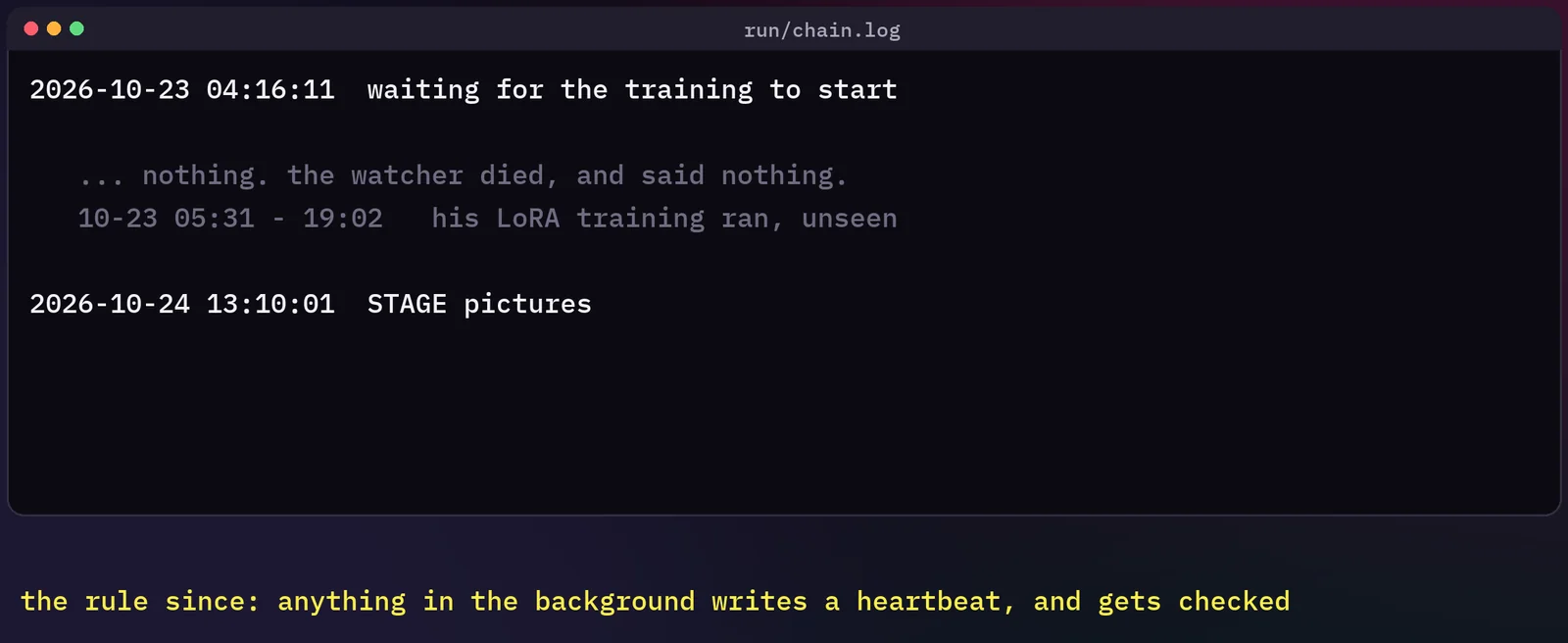
- The dead watcher (the RefMods video). It left a script waiting for my training to finish.
chain.logstops at 04:16 on 10-23 with no reason given; the training ran 05:31 to 19:02, nothing started, and I only found out by asking the next morning. I lost a day.
What rules keep Claude Code from wrecking a video?
Five rules: packaging before the script, checked work before it says done, a person's eye and ear on how things look and sound, permission before it touches the GPU, and notes it reads first. The notes matter most: after a few weeks, it stops making the same mistake twice.
- Packaging first: title and thumbnail before the script.
- Done means checked: it reads the words back, measures the sound and looks at the frames.
- Eye and ear are mine: full size and playing, not a contact sheet or a sharpness score.
- It asks before touching the GPU, because I'm usually rendering something myself.
- It keeps notes: each correction becomes a rule in a memory file it reads first. Since the watcher, anything in the background also writes a heartbeat that the agent checks.
How do you start using Claude Code for video editing?
Start with one recording and one job, not "make my whole video". Pick the job you hate most, which for me was captions, and give the agent only that. Check what it made by eye and ear, then add the next step.
- Get Claude Code, which the free Claude plan doesn't include, and ask it to install ffmpeg, Whisper and Python.
- Give it a small brief: "Here's my recording. Cut every pause longer than half a second, make captions, and spell ComfyUI right."
- Check the result yourself, by eye and ear.
- To render, add ComfyUI and the MCP server. New to ComfyUI? Start with the free Part 1 of ComfyUI From Zero, and keep the beginner errors guide open.
What are the limits of this test?
This is one video, one person, one session log and one RTX 5090: a record of what happened, not a benchmark.
- No other agent or human editor was compared.
- Claude Opus 5.5 in Claude Code 2.1.308, by the log.
- Tool calls are counted once each, because the log repeats some lines. The count leaves out 29 calls between the sittings (status checks and other work) and 60 read-only calls by one research sub-agent during production.
- The video's cards show 565 tool calls, 19:25 and 6 h 18 min for the production; the session log and the file's timestamp give 526 calls (565 with the 39 wrap-up calls), 19:15 and 6 h 8 min.
- The video's setup diagram shows the ComfyUI MCP server between Claude Code and ComfyUI; the session log shows no call through it on the RefMods video, where Python scripts posted each workflow to ComfyUI's
/promptAPI. - The tests ran on Ultimate H3 0.14; the pack is now at 0.15.1.
- The 10 messages leave out three short status messages between the sittings, and unrelated work in the same chat.
- The log shows what I typed, not what I watched, so it can't prove an eye or ear check. The sound and motion failures came from other projects.
Sources and files
- I Let Claude Code Run ComfyUI and Make My Whole MiniMax H3 Video (10:36): my setup from 2:04, step by step from 2:54, what it got wrong from 6:21, the five rules from 7:57 and try it yourself from 9:37.
- I Tested MiniMax H3 RefMods vs Reference Images for Long Videos: the video Claude Code made.
- anthropics/claude-code: Claude Code's GitHub page, by Anthropic.
- Comfy-Org/comfy-mcp: the ComfyUI MCP server.
- stuubszzz/Stubelius-Ultimate-H3: the workflow the tests ran in (MIT).
- The MiniMax H3 model card, by MiniMax, under the MiniMax H3 Community License: read it before commercial use.
- On this site: RefMods vs reference images, the Ultimate H3 workflow, ComfyUI errors and the ComfyUI From Zero course.
Common questions
Can Claude Code run ComfyUI?
Yes. On my Windows 11 PC it ran ComfyUI through Python scripts it wrote, which posted each workflow to ComfyUI's HTTP API. The other route is Comfy Org's free ComfyUI MCP server, which the video's setup shows but this run didn't call. I did not compare the two.
How much VRAM do I need to run Claude Code with ComfyUI?
No minimum comes out of this run, which used one RTX 5090 with 32 GB of VRAM. The need comes from what you render: MiniMax H3's files are about 51 GB on disk, and in my three-model test the whole card peaked at 30.4 GB with it in PDMD mode on that 32 GB card, which isn't a minimum.
Is Claude Code video editing free?
Partly. The free Claude plan doesn't include Claude Code: by Anthropic's setup docs, it needs a paid plan, an Anthropic Console account or a third-party API provider. ComfyUI, the ComfyUI MCP server, ffmpeg, Whisper, Python and the free version of DaVinci Resolve cost nothing, by the video's list.
Can Claude Code watch a video?
No, not the way a person does. It reads the transcript and numbers such as loudness, and looks at still frames, so it missed a leg morphing during a turn in one of my takes.
Does Claude Code replace a video editor?
No, not in my use. It did the rendering, cutting and captions on the RefMods video, but the direction and the eye and ear calls were mine. As the video puts it, it's a very fast editor that still needs a director.
Whose voice narrates the Claude Code video?
A clone of my own voice, made with Fish Audio Drama 3 on my own PC. I recorded nothing for that video, and the RefMods video used the same kind of clone.