STUUBZZZ
VBVR LoRA on MiniMax H3: 510 videos, +0.026 on the official benchmark, half my pass mark
 Watch the video · I Tested the Reasoning LoRA on MiniMax H3 With 510 Videos
On MiniMax H3, MisticRain69's VBVR Pro reasoning LoRA moved the official VBVR-Pro-Bench score from 0.272 to 0.298 and my checks from 83.3% to 85.8% (510 videos, RTX 5090). At 0.05, my control, it gained 1.2 points on the checks and nothing on the benchmark. In this test it missed both pass marks, so it isn't in my workflow.
- On VBVR-Pro-Bench (100 tasks scored 0 to 1, RTX 5090, October 2026), MiniMax H3 at 4 steps scored 0.272 without the H3 VBVR Pro LoRA and 0.298 with it, against a +0.05 pass mark. A 0.05-strength control scored 0.272.
- On 42 of my own MiniMax H3 shots × 2 seeds (RTX 5090, two blind AI judges), the VBVR Pro LoRA lifted checks from 83.3% to 85.8%: +2.5 points against a +5 pass mark. The control gained 1.2 on one seed.
- Across 84 same-seed MiniMax H3 pairs on an RTX 5090, the VBVR Pro LoRA changed saturation +2.2%, motion −3.0% and loudness −0.4 dB (medians), with median render time unchanged at about 59.5 s. Every scripted line was spoken, but one candle shot went fully silent.
- MiniMax H3's first VBVR-Pro-Bench score is 0.272 (1 of 5 instances per task, 4 steps, RTX 5090): above the paper's LTX 2.3 (0.112) and Wan 2.2 (0.182), and close to Veo 3.1 (0.309), though not directly comparable, because the paper's scores use all 5 instances.
What is the VBVR Pro reasoning LoRA for MiniMax H3?
H3 VBVR Pro is a LoRA for MiniMax H3 by MisticRain69, published on Civitai: rank 16, attention layers only, 66 MB, trained on 1,000 puzzle clips from Video-Reason's VBVR-Pro set. It is a community LoRA, not an official release. MiniMax H3 is MiniMax's video model with sound, generating the picture and the audio in the same pass.
The research behind it is VBVR, "A Very Big Video Reasoning Suite", by Video-Reason: about a million generated puzzle videos, such as mazes, sorting and traffic lights, each a first frame, an instruction and the right answer as a video. On the VBVR-Pro paper's benchmark, Wan 2.2 went from 0.182 to 0.670 after training. That is a full fine-tune on very large data; this LoRA saw 1,000 clips.
What does the VBVR LoRA claim to do?
By its author's notes, the H3 VBVR Pro LoRA gives more literal prompt following, motion with purpose ("things that shouldn't move, move less") and better temporal consistency, with no style change and no new abilities. The pass marks below are mine, not the author's promises.
The notes also say: trained for image-to-video, text-to-video untested, strength 1.0, and literal prompts from starting state to action to end state. I wrote my 42 prompts that way, for all versions.
How did I test the VBVR LoRA?
I rendered 510 H3 clips on one RTX 5090, 0 failed, in three versions, all with the PDMD 4-step LoRA: no VBVR LoRA, the LoRA at 1.0, and a control at 0.05. Each shot kept its prompt and seed across versions. I wrote the pass rules on 2026-10-10, before the first render.
On H3's int8 model even a tiny LoRA leaves a mark on every frame, so some differences are pure chance. The control shows how big chance is.
- Official benchmark, 300 clips. VBVR-Pro-Bench is Video-Reason's benchmark of 100 visual-reasoning tasks, 50 of task types the LoRA trained on and 50 new. Code scores each clip from 0 to 1, and the reference answers scored 0.997 on my run.
- My own shots, 210 clips. 32 real shots and 10 puzzles, with yes/no checks written before rendering. Two seeds without and with the LoRA, one for the control. Two blind AI judges answered from 12-frame contact sheets under shuffled letters and agreed on 96% of answers. Sound checks were scored from the audio.
To pass, the LoRA needed +5 points on my checks, with the interval above 0 and the control, or +0.05 on the benchmark with my checks down 3 points at most. It also had to stay inside limits on motion, colour, speech and sound.
Tested 2026-10-10 and 2026-10-11 on an RTX 5090 (32 GB), 96 GB RAM, Windows 11. Stubelius Ultimate H3, PDMD mode, 4 steps, 24 fps. About 6.6 GPU hours.
What does MiniMax H3 score on VBVR-Pro-Bench without the VBVR LoRA?
MiniMax H3 scored 0.272 on VBVR-Pro-Bench out of the box, on a scale of 0 to 1, with a 90% interval of 0.216 to 0.329 over tasks. It wasn't on the leaderboard when I tested, so this is its first score, at 4 steps on 1 of the 5 instances per task.
| Model | Score |
|---|---|
| LTX 2.3 | 0.112 |
| Wan 2.2 I2V | 0.182 |
| MiniMax H3, no VBVR LoRA | 0.272 |
| Veo 3.1 | 0.309 |
| Kling V3 | 0.392 |
| Seedance 2.0 | 0.499 |
Read the H3 row with care: the paper's scores use all 5 instances and count missing ones as 0, while mine averages the 100 clips I rendered.
Does the VBVR LoRA raise the benchmark score?
Yes, a little: +0.026, half the +0.05 I asked for. The interval crosses zero, but the moves lean positive and the control shows no drift, so it likely has a small real effect.
| Version | Score | Change | 90% interval | Better / worse | Sign test p |
|---|---|---|---|---|---|
| No LoRA | 0.272 | – | – | – | – |
| VBVR Pro at 1.0 | 0.298 | +0.026 | −0.013 to +0.065 | 32 / 15 | 0.019 |
| Control at 0.05 | 0.272 | −0.000 | −0.012 to +0.011 | 13 / 16 | 0.71 |
The gain was +0.038 on task types the LoRA trained on and +0.015 on new ones.
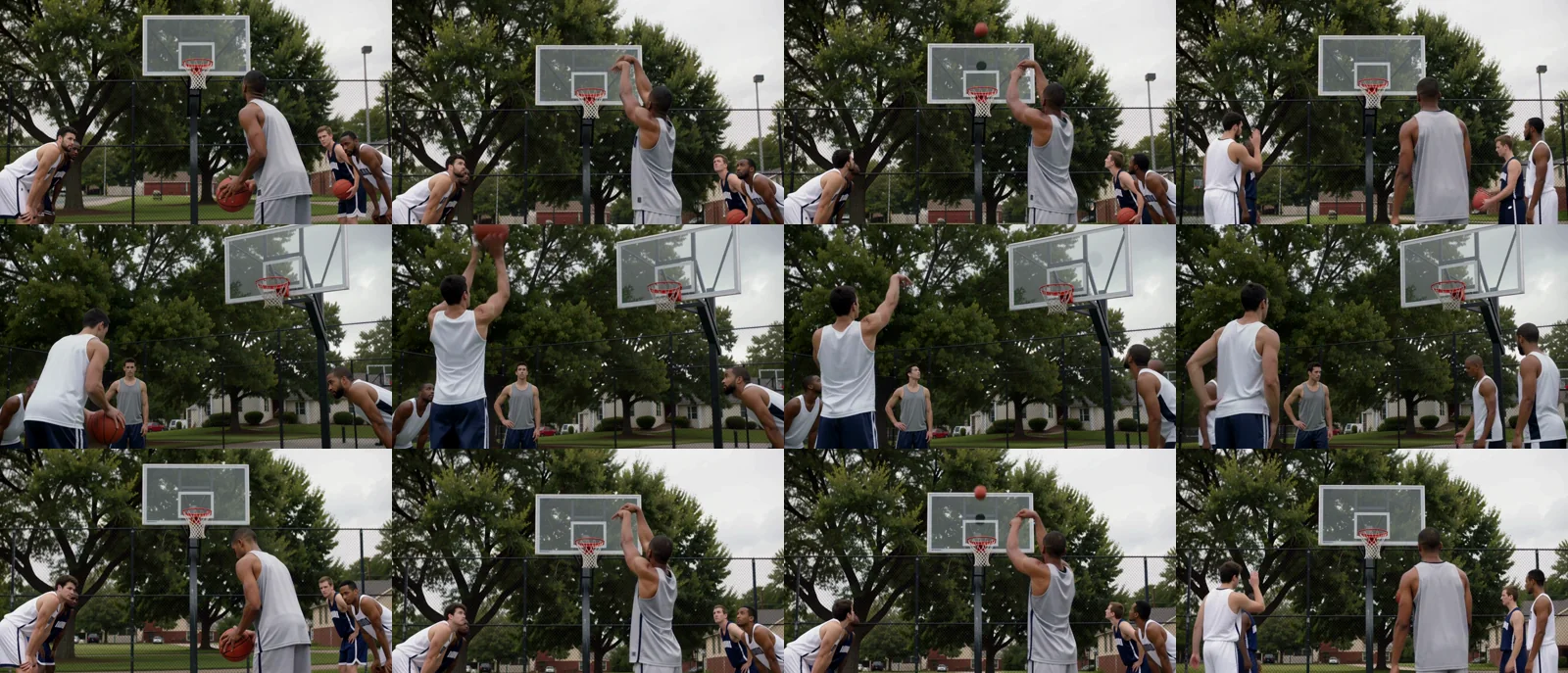
In the four biggest movers, mostly the picture changed, not the answer. On a domino chain (0.02 to 0.89) and a floorplan (0.19 to 0.92), both versions got it right, but without the LoRA the diagram became a 3D photo or filled with text.
The other two fell to 0.00 with the LoRA: a wrong shape circled, and a junk text banner.
So the LoRA may help H3 stay in the flat style it trained on. That is a hint from 4 tasks, not a result.
Does the VBVR LoRA improve prompt following on real shots?
Barely, in this test. On 32 real shots × 2 seeds, H3 passed 86.5% of checks without the LoRA and 88.2% with it, +1.7 points with an interval that crosses zero. The control gained 0.5 on one seed. Over all 42 shots the gain was +2.5 points, half the +5 needed.
| Scope | No LoRA | VBVR Pro | VBVR Pro change | Control change |
|---|---|---|---|---|
| All 42 shots | 83.3% | 85.8% | +2.5 (+0.5 to +4.6) | +1.2 (−0.1 to +3.0) |
| 32 real shots | 86.5% | 88.2% | +1.7 (−0.2 to +3.7) | +0.5 (−0.6 to +2.0) |
| 10 puzzles of mine | 73.1% | 78.1% | +5.0 (−0.6 to +11.2) | +3.8 (+0.0 to +8.8) |
Single checks moved both ways, and the control moved them too, so single-shot stories are mostly seed luck.
| Check | No LoRA | VBVR Pro | Control |
|---|---|---|---|
| Birds fly off one at a time | 50 | 100 | 0 |
| Cola glass doesn't overflow | 100 | 50 | 100 |
| Basketball: one ball only | 50 | 100 | 100 |
| Latte: a heart forms in the foam | 50 | 50 | 100 |
On the basketball row, without the LoRA a bystander held a second ball on seed 1001. The LoRA fixed it, and so did the control, at a strength that should do almost nothing. That is chance, not reasoning.
Does the VBVR LoRA help H3 solve a maze?
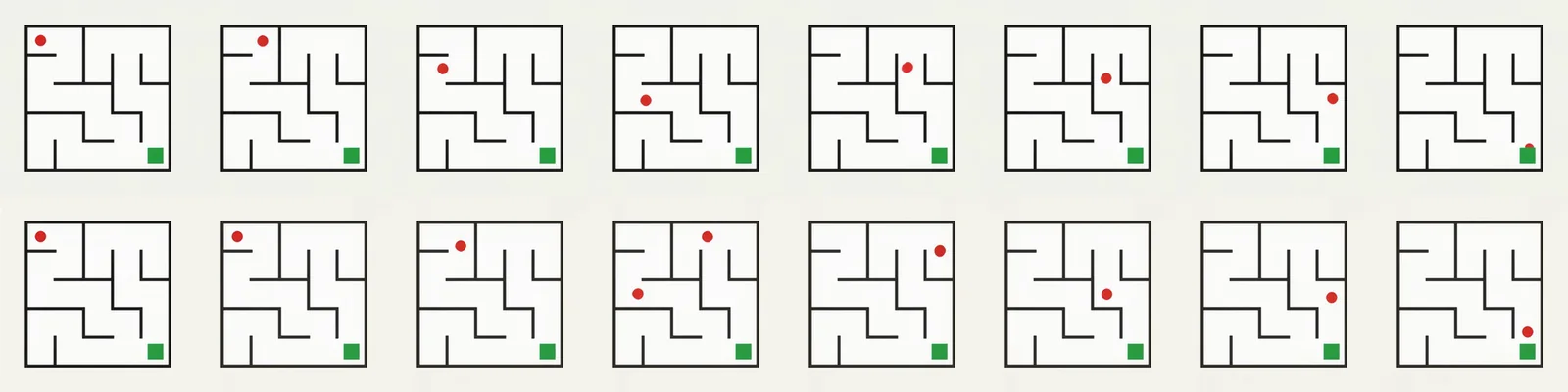
It's a draw. With the LoRA, one seed solved my maze perfectly and the other never reached the goal. Without it, the tracked red dot reached the goal on both seeds, crossing one wall each time.
| Clip | Valid progress | Wall crossings | Reached the goal |
|---|---|---|---|
| No LoRA, seed 1001 | 0.6 | 1 | Yes |
| Control, seed 1001 | 0.6 | 2 | Yes |
| VBVR Pro, seed 1001 | 0.2 | 3 | No |
| No LoRA, seed 2002 | 0.8 | 1 | Yes |
| VBVR Pro, seed 2002 | 1.0 | 0 | Yes |
What does the VBVR LoRA cost in motion, picture and sound?
Almost nothing, apart from one silent clip. Across 84 same-seed pairs, median motion fell 3.0% and saturation rose 2.2%, well inside my limits, and median render time stayed the same (about 59.5 s; +3% on the benchmark clips). My rule allowed no new silence, so the candle shot counts as a harm flag.
| Measure | Result | Limit |
|---|---|---|
| Motion | −3.0% | Down 20% at most |
| Saturation | +2.2% | Within ±8% |
| Word error, 4 dialogue clips | 0.05, same as no LoRA | Up 0.15 at most |
| Voice match to no LoRA, by seed | 0.968, 0.945 (control 0.975) | 0.03 below the control at most, on seed 1001 |
| Clips gone silent | 1 (candle, seed 1001) | None |
- Silence: my puzzles ask for silence, and 11 of 20 went fully silent with the LoRA against 8 without. The training clip format lists no sound, which fits, on a small sample.
- Things that shouldn't move: stillness checks passed 100% in every version. First-to-last-frame change on the four stillness clips was slightly higher with the LoRA, not lower.
- The picture: same-seed frame match to no LoRA was 0.570 on SSIM, a frame-similarity score where higher means closer, against 0.729 for the control. At 1.0 the LoRA reshuffles more of the picture, but the detail and colour look stay the same.
Should you use the VBVR LoRA on MiniMax H3?
Not for real shots, in this test: by the rules I wrote beforehand, I don't recommend the VBVR Pro LoRA, and it isn't going into my workflow. H3 already does most of this on its own. For flat diagrams or puzzle-style animation it's worth a try, since it adds almost no render time.
| Rule | Needed | Measured | Outcome |
|---|---|---|---|
| Official benchmark | +0.05 | +0.026 | Missed |
| My checks | +5 points, beyond the control | +2.5 points, control +1.2 | Missed |
| No harm | Inside every limit | One clip lost its sound | One flag |
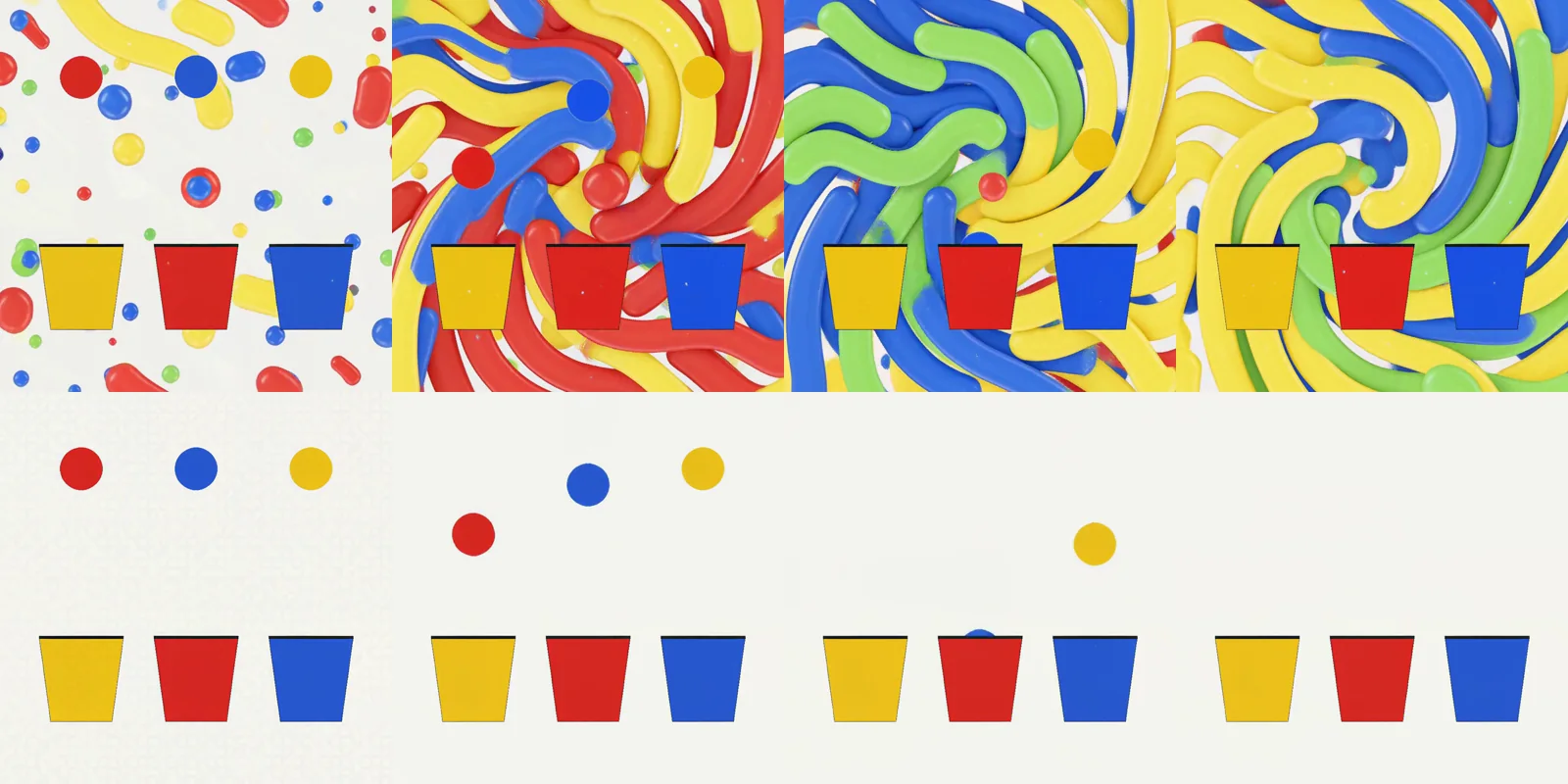
Keeping a picture flat is not the same as solving it. On my sorting puzzle (seed 2002) the LoRA held the flat look, and both judges still saw every ball land in the wrong cup.
How do I try the VBVR LoRA in Stubelius Ultimate H3?
The H3 VBVR Pro LoRA is published on Civitai by MisticRain69, so look for it there by that name; I don't link the page because it's flagged for mature content. Put the file in models/loras, then pick it in the extra_lora_1 slot on the Models node at strength 1.0, the strength I tested and the author's recommendation.
- Update Stubelius Ultimate H3 from GitHub main. PDMD mode is in 0.10 and later.
- Put the LoRA in
models/loras(model folders) and setextra_lora_1andextra_lora_1_strengthon the Models node. - Set
modetoPDMDon the Setup node and pick the file inpdmd_lora, as in my 4-step test. - Write the prompt step by step in MiniMax H3's three fields. Part 2 of ComfyUI From Zero covers structured prompting.
What are the limits of this test?
This is one card, one LoRA version and two strengths in 4-step PDMD mode, scored by code and AI judges; how I test covers the general method.
- One RTX 5090, no other cards.
- PDMD at 4 steps only. I did not test Quality mode.
- Strengths 1.0 and 0.05 only. The plan named a 0.01 control; I ran 0.05, the slot's smallest step.
- The benchmark ran 1 of 5 instances per task, one seed, no sound.
- Of my 42 shots, 21 were text-to-video, which the author lists as untested, 10 image-to-video, 10 puzzles from a first frame and 1 in Reference mode.
- The judges are AI models reading 12 frames per clip. On seed 1001, the tracker has the dot reaching the goal without the LoRA; the judges saw no arrival.
- Lip-sync offset and temporal consistency had no dedicated measure. I have not re-run this on Ultimate H3 0.15.1.
Sources and files
- I Tested the Reasoning LoRA on MiniMax H3 With 510 Videos: the test at 1:53, H3's first score at 3:13, 42 shots at 4:17, the maze at 5:50, side effects at 6:12 and the verdict at 7:01.
- H3 VBVR Pro LoRA by MisticRain69, on Civitai: the version dated 7 Sep 2026, my copy named
H3_VBVR_Pro_attn_only.safetensors. - VBVR and VBVR-Pro by Video-Reason, and the VBVR-Pro-Bench repo. The benchmark's data is CC BY-NC 4.0, so I show only its scores, not its videos.
- MiniMax H3 model card, under the MiniMax H3 Community License, and the PDMD 4-step LoRA.
- stuubszzz/Stubelius-Ultimate-H3: my free workflow.
- On this site: sampler settings and training a MiniMax H3 character LoRA.
Common questions
Does the VBVR LoRA work better for image-to-video?
No sign of it on real shots in this test: 10 image-to-video shots × 2 seeds went from 90.9% to 90.4% of checks with the LoRA, 21 text-to-video shots from 83.8% to 86.6%. My 10 first-frame puzzles gained 5.0 points, but the control gained 3.8 there.
How much VRAM does the VBVR LoRA add?
About 55 MB of peak VRAM on an RTX 5090 (32 GB). My 4-step runs peaked at about 28 to 31 GB with or without it, not a tested minimum.
Would a VBVR LoRA strength above 1.0 help?
Unknown: I ran 1.0 and the 0.05 control, not 0.5 or 1.5, so nothing here supports going higher. The author's recommended strength is 1.0. To check it yourself, run 1.5 against 1.0 on the same puzzles and seeds, with a 0.05 control to show chance.
How well does MiniMax H3 follow step-by-step prompts without the VBVR LoRA?
Well on real shots: 86.5% of my yes/no checks passed on 32 shots × 2 seeds, in 4-step PDMD mode on an RTX 5090. Puzzles are harder for it, at 73.1% on my 10.
Is the VBVR LoRA free, and where do I get it?
I can't confirm that: my notes record no price for the H3 VBVR Pro LoRA, so check its page. It is published on Civitai by MisticRain69, so look for it there by that name; the page is flagged for mature content, so I don't link it. I tested the version dated 7 Sep 2026. Its terms are the author's, on that page: read them yourself; this isn't legal advice.