STUUBZZZ
Pika H3 Flex on MiniMax H3 in ComfyUI: sound test against PDMD and FastH3 Omni, 75 clips
 Watch the video · I Tested Pika H3 Flex on MiniMax H3 With 75 Clips
To my ear, Pika H3 Flex by Pika has the clearest sound of three fast MiniMax H3 routes in ComfyUI, in my 75-render test on an RTX 5090. The measured edge over PDMD and FastH3 Omni is small, under 2 dB more top end across 54 takes, and a 15-second clip takes about 1.5 times PDMD's time.
- For MiniMax H3 in ComfyUI, pick Pika H3 Flex when people talk and the sound matters, FastH3 Omni for the smoothest motion and PDMD for quick short clips. That is my call from a 75-render test on an RTX 5090, October 2026.
- By one listener's ear, not a blind test, Pika H3 Flex on MiniMax H3 sounded clearest against PDMD and FastH3 Omni, with the least distortion and background noise. Over 54 takes, 18 per model, the measured edge is small: energy above 8 kHz was −25.2 dB for Flex, −26.8 for PDMD and −27.0 for FastH3 Omni, and the quiet gaps −42.5, −37.7 and −41.2 dB.
- On an RTX 5090 at 1344×768, a 15-second MiniMax H3 clip took 238–252 s with Pika H3 Flex, 167–172 s with PDMD and 149–157 s with FastH3 Omni (fastest of three seeds, on each of four clips).
- In 12 MiniMax H3 takes of 15 s, Pika H3 Flex held 233 frames (6 takes held none), PDMD 91 and FastH3 Omni 1. The Ultimate H3 de-stutter took one 24-second Flex video from 71 held frames to 1.
- Stubelius Ultimate H3 0.15.1, a free MiniMax H3 pack on GitHub main since 2026-10-31, has a Pika H3 Flex mode. In 24-second videos made in two chunks, the voice in chunk 2 matched the voice clip at 0.89–0.91 (WavLM) when it stayed in Reference, against 0.66–0.72 on the First/Last model (3 seeds each, RTX 5090).
What is Pika H3 Flex?
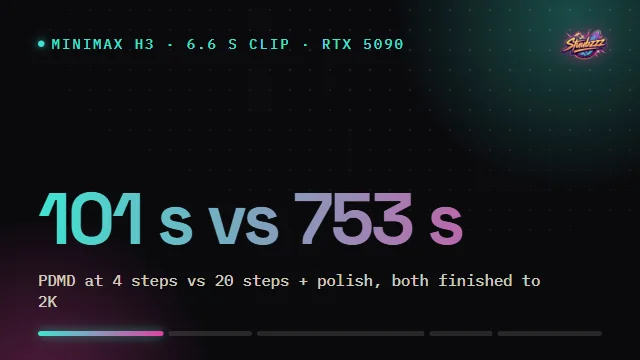
Pika H3 Flex is a version of MiniMax H3 fine-tuned by Pika and distilled to 6 steps, delivered as one LoRA for each of H3's two models, Reference and First/Last Frame. Pika announced it on 2026-10-29, and the files went up on Comfy-Org's MiniMax H3 page the same day. In an earlier round of my test, it was about three times faster than plain H3 at 20 steps.
On two 15-second clips in that round, Flex's fastest takes took 241 and 255 s. One plain H3 take of each, without the polish pass, took 784 and 812 s. The two files, 1.96 GB each, have the same keys and different weights, so they aren't interchangeable. Flex also needs its own sampler settings: lcm on a fixed list of six steps, full strength and H3's own 12 / 3 flow shift.
MiniMax H3 is MiniMax's video model with sound: it generates the picture and the audio in the same pass. ComfyUI is a free, open-source program that runs image and video models on your own computer or on a rented GPU.
How did I run the test?
I rendered 7 kinds of clip on 3 routes with 3 seeds each, plus a 24-second video in two chunks through my workflow: 75 renders and no failures. Every route got the same prompts, picture, voice clip and seeds at 1344×768, on its own settings. PDMD is a LoRA that takes H3 to 4 steps, and FastH3 Omni is a Reference checkpoint distilled to 8.
| Route | By | Steps | Form |
|---|---|---|---|
| PDMD | Zimo Wang et al. | 4 | A LoRA |
| FastH3 Omni | FastVideo (Hao AI Lab) and Nuva Lab | 8 | Its own Reference checkpoint, with sparse attention (VSA) |
| Pika H3 Flex | Pika | 6 | One LoRA per H3 model |
The subject is a new character, a salvage diver in an old brass suit, with a picture from Qwen-Image 2.1 and a voice clip from VoxCPM2 voice design.
- 8 seconds: a close-up with lip sync, a turn from profile to front, and a laugh that goes cold.
- 15 seconds: a run and a jump, hands and sparks, a swim with no speech, and a radio call inside the helmet.
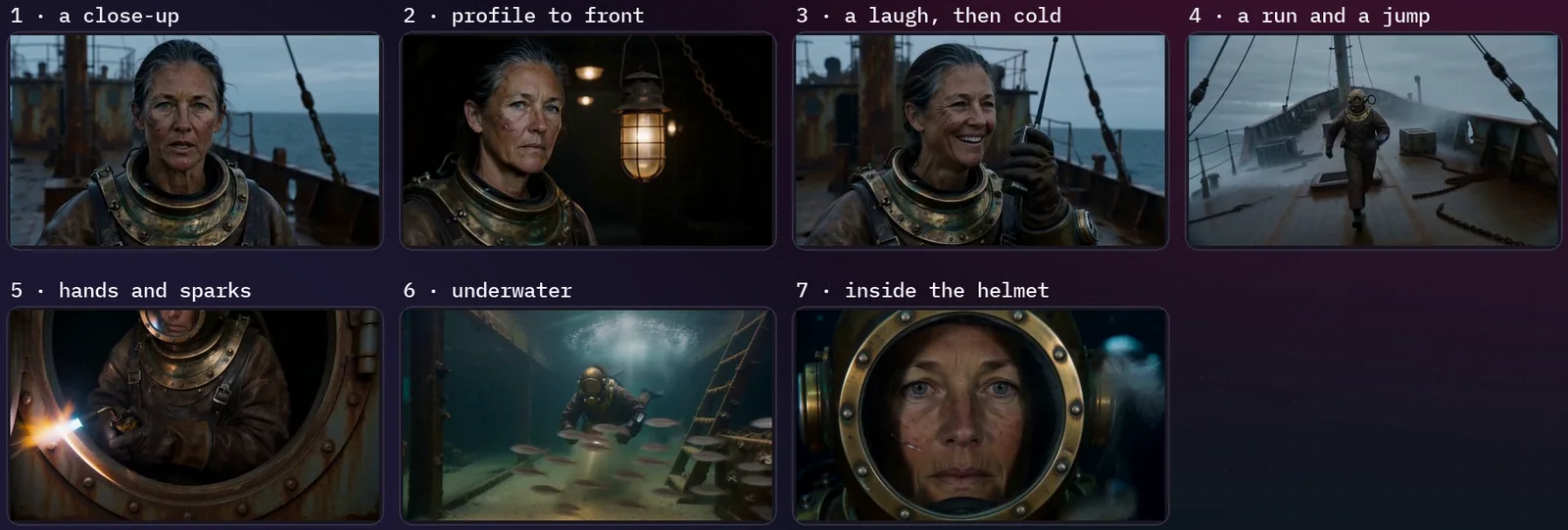
Tested 2026-10-30 and 2026-10-31 on an RTX 5090 (32 GB), 96 GB RAM, Windows 11, ComfyUI 0.43.0. MiniMax H3 in Reference mode. More on how I test.
Which sounds clearest, Pika H3 Flex, PDMD or FastH3 Omni?
Pika H3 Flex, to my ear: it sounded the clearest of the three, with the least distortion and background noise. That is one person's call, not a blind test: my comparison reels label each route and play them in a fixed order at matched loudness. The measurements lean the same way, but only a little.
| Route | Top end | Quiet gaps |
|---|---|---|
| Pika H3 Flex | −25.2 | −42.5 |
| PDMD | −26.8 | −37.7 |
| FastH3 Omni | −27.0 | −41.2 |
| Clip | Top end, PDMD | Top end, Omni | Top end, Flex | Gaps, PDMD | Gaps, Omni | Gaps, Flex |
|---|---|---|---|---|---|---|
| Close-up | −30.7 | −29.9 | −27.1 | −39.4 | −47.9 | −47.4 |
| Profile to front | −25.1 | −24.7 | −24.5 | −36.2 | −38.2 | −38.8 |
| Laugh | −27.1 | −24.4 | −23.9 | −37.3 | −42.1 | −38.6 |
| Run and jump | −27.0 | −30.9 | −28.9 | −36.0 | −39.6 | −41.5 |
| Hands and sparks | −26.4 | −27.6 | −25.5 | −40.4 | −40.8 | −46.7 |
| Inside the helmet | −24.3 | −24.5 | −21.0 | −36.7 | −38.4 | −42.0 |
| All 54 takes | −26.8 | −27.0 | −25.2 | −37.7 | −41.2 | −42.5 |
Flex had the most energy above 8 kHz on 5 of the 6 clips and the quietest gaps on 4 of the 6. It isn't a sweep: PDMD had more top end on the run, FastH3 Omni quieter gaps on the close-up and the laugh, and Flex's top-end lead ran from about 0.1 dB on the profile clip to about 3.3 dB inside the helmet.
Top end is the share of energy above 8 kHz in the clip's loud parts; gaps are the quiet parts, measured against the loud ones. Both count all the sound in the clip, and neither measures clarity itself. So don't take my word for it: the sound chapter plays the clips level-matched for your own headphones.
Is Flex's picture as good as the other two?
Almost, but not quite, by my eye: Pika H3 Flex's picture sits a little behind PDMD and FastH3 Omni when you compare them side by side. The diver's face holds up fine. In some takes, I felt the background was a bit better on the other two.
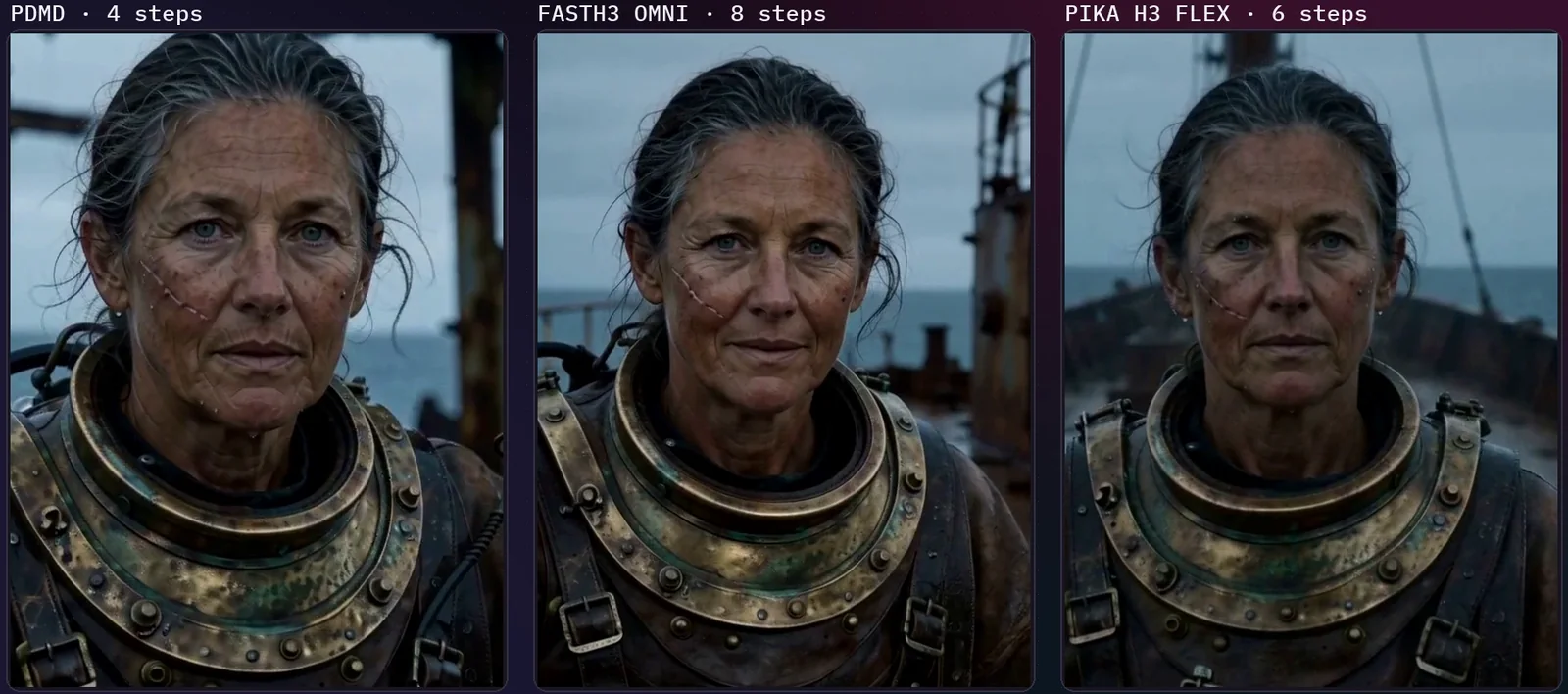
A face score doesn't show this. ArcFace, a face-recognition model, compared each take with her picture and gave Flex the highest match on all three face clips: 0.77, 0.82 and 0.76, against 0.72, 0.77 and 0.74 for PDMD and 0.74, 0.78 and 0.68 for FastH3 Omni. That measures likeness, not how good the frame looks.
Does Pika H3 Flex stutter more than PDMD and FastH3 Omni?
Yes, in this test: Pika H3 Flex held 233 frames in 12 takes of 15 seconds, against 91 for PDMD and 1 for FastH3 Omni. A held frame is one where the picture stops for a frame, and a steady rhythm of them reads as stutter. Half of Flex's takes held none.
| Route | Held frames | Takes with none |
|---|---|---|
| FastH3 Omni | 1 | 11 of 12 |
| PDMD | 91 | 8 of 12 |
| Pika H3 Flex | 233 | 6 of 12 |
Flex also moves more calmly. In the run and the jump, it measured 5.1 pixels of optical flow per frame against 8.2 for PDMD and FastH3 Omni (three seeds each), over a third less. It had the lowest flow on 5 of the 7 clips, though flow counts how much moves, not how well.
The workflow's de-stutter draws held frames again with RIFE, a frame-interpolation model. On its default auto it would fire on 4 of Flex's 12 takes, 1 of PDMD's and none of FastH3 Omni's. On a Finish, it took one 24-second Flex video from 71 held frames to 1.
How long does it take to render?
About 1.5 times PDMD: a 15-second clip took about four minutes with Pika H3 Flex, against under three for PDMD and FastH3 Omni. That is about 1.6 times FastH3 Omni.
| Length | PDMD | FastH3 Omni | Pika H3 Flex |
|---|---|---|---|
| 8 s | 64–79 | 76–85 | 87 |
| 15 s | 167–172 | 149–157 | 238–252 |
| 24 s in two chunks | 289–297 | 319–324 | 428–437 |
Flex's 24-second row is chunk 2 in Reference, as the mode does it. On the First/Last model it took 418–445 s.
Does Flex get the dialogue right?
Yes, almost always: across all three routes, 104 of 105 lines were spoken word for word, scored by Whisper large-v3, OpenAI's speech recognition model. The one miss was a Pika H3 Flex take of the run and the jump.
Clearest doesn't mean closest to the voice clip. On WavLM, Microsoft's speaker-matching model, Flex was closest on none of the five clips scored: 0.92 on the close-up, against 0.95 for PDMD and 0.96 for FastH3 Omni, and 0.85 on the run, against 0.88 and 0.95.
Does Pika H3 Flex keep the same voice in long videos?
Yes, if the video stays in Reference. Long videos render in chunks, and in chunk 2 of a 24-second video the voice matched my voice clip at 0.89–0.91 with Pika H3 Flex; my scoring counts 0.86 and up as the same speaker. With chunk 2 on the First/Last model it fell to 0.66–0.72 (3 seeds each). So the mode stays in Reference.
| Route | Chunk 2 renders on | Voice match |
|---|---|---|
| PDMD | First/Last model | 0.72–0.75 |
| FastH3 Omni | Reference | 0.90–0.96 |
| Pika H3 Flex | First/Last model | 0.66–0.72 |
| Pika H3 Flex, as the mode does it | Reference | 0.89–0.91 |
The First/Last model takes no voice clip. How far the voice falls varies: on my earlier round with another character, chunk 2 on First/Last scored 0.83–0.89 and in Reference 0.89–0.92. Long videos in Ultimate H3 explains the chunks.
How do I use Pika H3 Flex in ComfyUI?
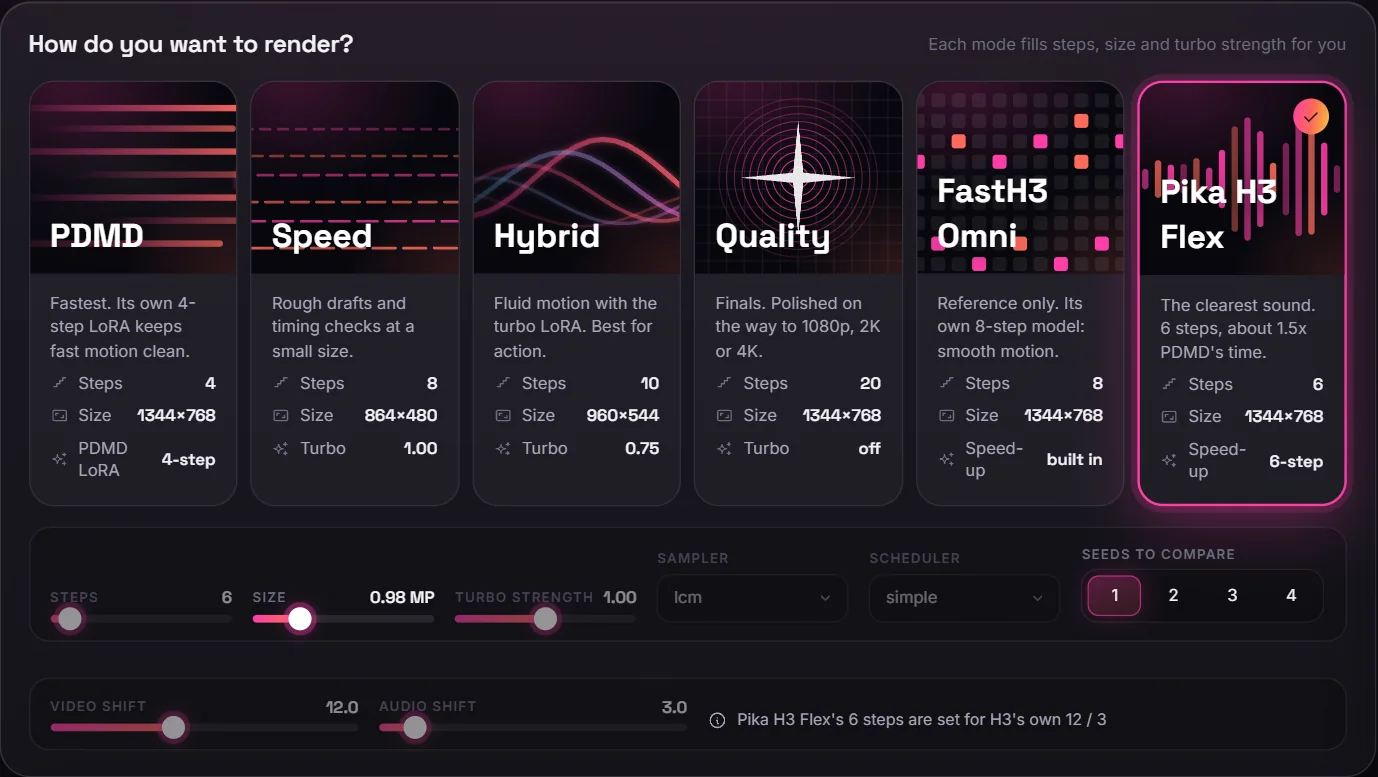
Update Stubelius Ultimate H3, my free MiniMax H3 workflow pack, to 0.15.1, put the two Flex files in models/loras and pick Pika H3 Flex in the Setup window. It is the pack's sixth mode, and it sets the sampler, the steps and the right file for each model.
- Run
git pullincustom_nodes/Stubelius-Ultimate-H3, or Update All in Manager, then restart ComfyUI. - Download
pika_h3_flex_ref2va_v1_bf16.safetensorsandpika_h3_flex_fl2va_v1_bf16.safetensorsfrom Comfy-Org/MiniMax-H3 intomodels/loras(model folders). The mode needs both, and it stops if they are swapped. - In Setup, pick the Pika H3 Flex card. The turbo LoRA isn't used.
- In the Director, a Reference video stays in Reference, so your voice clip reaches every chunk.
- In Output, pick native (about 768p), 1080p, 2K or 4K. There is no polish in this mode.
Which should you use, Pika H3 Flex, PDMD or FastH3 Omni?
Pick Pika H3 Flex when people are talking and the sound matters, FastH3 Omni for the smoothest motion, and PDMD for quick short clips. None of the three wins everything in my 75-render test, which is why all three are in the workflow.
- Pika H3 Flex: speech and sound first, if you can spare about 1.5 times PDMD's time and a slightly weaker picture.
- FastH3 Omni: motion. It held 1 frame in 12 long takes, and was fastest at 15 seconds, but it is Reference mode only.
- PDMD: quick short clips. It was fastest at 24 seconds and, by fastest take, on two of the three 8-second clips (see the PDMD 4-step test).
Choosing between whole models? See LTX 2.5 vs MiniMax H3 vs Kandinsky 6. New to all this? Start with the free Part 1 of ComfyUI From Zero.
What are the limits of this test?
This is one person's test on one card with one character, so treat its numbers as one measured case and not as a general result.
- 75 renders on one RTX 5090: 7 clips × 3 routes × 3 seeds (63), plus 4 set-ups × 3 seeds through the workflow (12). One character, one picture, one voice clip. An earlier round on another character brings the total to 138.
- The sound and picture calls are mine alone, with no blind test and no other listeners.
- The sound numbers are means, and I ran no significance test on a difference of 1 or 2 dB. Table cells are rounded: Flex's 0.2 dB top-end lead on the profile clip is about 0.1 dB before rounding.
- Render times quote each clip's fastest take. PDMD's 8-second takes ran 64 to 248 s, median 101 s; FastH3 Omni's median was 85 s and Flex's 87 s.
- Held frames vary by clip: on the earlier round, two 15-second Flex clips held 270 and 273 frames over three takes each. The 71-to-1 de-stutter result is one render.
- Not tested: other cards, a minimum for VRAM, upscaled output, or more than a few First/Last Frame takes.
Sources and files
- I Tested Pika H3 Flex on MiniMax H3 With 75 Clips: sound at 3:04, picture at 4:37, motion at 5:02, render time at 5:39, chunk 2 at 6:08, the mode at 6:46.
- Pika H3 Flex by Pika: the model card, the launch post and the ComfyUI files on Comfy-Org, under the MiniMax H3 Community License.
- The Pika H3 Flex mode in the Ultimate H3 README (MIT), and the MiniMax H3 model card, under the MiniMax H3 Community License.
- On this site: FastH3 Omni vs PDMD, PDMD vs SoL Refiner and the ComfyUI From Zero course.
Common questions
Is the Pika H3 Flex mode free?
Yes. The mode is part of Stubelius Ultimate H3, which is MIT licensed and public on GitHub. The two Flex files are a separate download under the MiniMax H3 Community License: read it yourself before commercial use; this isn't legal advice.
How much VRAM does Pika H3 Flex need?
Each Flex LoRA adds 1.96 GB on disk, and MiniMax H3 in PDMD mode peaked at 30.4 GB on a whole 32 GB card in my LTX 2.5 vs MiniMax H3 vs Kandinsky 6 test, which isn't a minimum. This Flex test didn't record peak VRAM, and an RTX 5090 is the only card I tested.
Can I use Pika H3 Flex without Stubelius Ultimate H3?
Yes. ComfyUI has its own Flex templates, such as video_pika_h3_flex_ref2va. They run lcm on the sigmas 1.0, 0.972973, 0.923077, 0.8, 0.571429, 0.333333 and 0.0, with the LoRA at 1.0.
Does Pika H3 Flex work in First/Last Frame mode?
Yes, on its own fl2va file. Three 15-second First/Last takes held no frames, the fastest at 255 s, and one 8-second take held 18 (0 after the de-stutter).
Can I change the steps or the sampler in Pika H3 Flex mode?
No. Ultimate H3 locks the 6 steps, the lcm sampler, the LoRA strength and the 12 / 3 shift, the settings of ComfyUI's Flex templates. The size and the seeds stay yours.