STUUBZZZ
MiniMax H3 sampler and scheduler settings: three safe pairs, two that break
 Watch the video · I Blind Ranked the Top MiniMax H3 Workflows on Civitai
On five public MiniMax H3 workflows, three sampler and scheduler pairs rendered without a gross failure every time: euler/simple, euler/beta and er_sde/beta. Two pairs broke at 6 to 14 steps: dpmpp_2m_sde/karras produced noise instead of a picture on four of five workflows, and res_multistep/beta gave speckle or a colour failure on three of five.
- In a 29-render test on one RTX 5090 (32 GB) on 2026-09-20,
euler/simple,euler/betaander_sde/betaproduced no gross failure on any of five public MiniMax H3 workflows running 6 to 14 steps. dpmpp_2m_sdewith thekarrasscheduler produced noise instead of a picture on four of five MiniMax H3 workflows at 6 to 14 steps, one seed each on an RTX 5090. The fifth rendered a picture with visible speckle.res_multistepwith thebetascheduler gave heavy speckle or a pink or magenta colour failure on three of five MiniMax H3 workflows at 6 to 8 steps.res_multistepwithsimpleat 8 steps, which one of the five ships, showed neither problem.- The five MiniMax H3 workflows in this test, in the versions I had from Civitai on 2026-09-20, ship five different defaults:
euler/simpleat 8 steps,er_sde/betaat 6,er_sde/beta57at 8,res_multistep/simpleat 8 andeuler/beta57at 14. - The sample is one fight shot, one seed (443430), 1344x768 and 5 seconds, with each workflow at its own shipped step count. The three safe pairs are not ranked against each other.
Which sampler and scheduler pairs are safe on MiniMax H3?
Three pairs rendered with no gross failure on all five workflows: euler/simple, euler/beta and er_sde/beta. The other two failed on three or more of the five. I ran the same five pairs through five popular MiniMax H3 workflows from Civitai and changed only the sampler and the scheduler. Each workflow kept its own checkpoint, LoRAs, speed tricks and step count. None of the five ships either of the two failing pairs. Those are my substitutions.
| Sampler / scheduler | Ultra Fastest v9.0 (8 steps) | PlagueKind V9 (8 steps) | Seed Hunter v2.0 (6 steps) | EZ V4.1 (8 steps) | Multishot v2.7 (14 steps) |
|---|---|---|---|---|---|
euler/simple | OK | OK | OK | OK (shipped default) | OK |
euler/beta | OK | OK | OK | OK | OK |
er_sde/beta | OK | OK | OK (shipped default) | OK | OK |
res_multistep/beta | Heavy speckle over the whole frame | No gross failure, washed and brighter | Blown-out pink and white | Washed magenta and green cast | No gross failure, washed and brighter |
dpmpp_2m_sde/karras | Picture survives, visible speckle | Noise, no usable picture | Noise, no usable picture | Noise, no usable picture | Noise, no usable picture |
OK means a recognisable picture with no noise and no colour blow-out. It does not mean the three safe pairs are equal, and I am not ranking them. Each pair gave a different take of the scene, and my first pass picked between them from six-frame contact sheets, where the brightest clip tends to win. I have not repeated that at full size on all five workflows. One look at 1:1, on single frames from the PlagueKind clips on 2026-09-24, found no difference in picture quality between the three.
Tested 2026-09-20 on an RTX 5090 (32 GB), 96 GB RAM, Windows 11. Text-to-video, 124 frames at 24 fps. One shot, one seed per setting, 29 renders.
Why does dpmpp_2m_sde with karras turn into noise?
My working explanation is that the karras curve, spread over only 6 to 14 steps, does not suit H3. That is an inference, not a measurement. What the test shows is narrow. This pair gave noise at 6, 8, 8 and 14 steps on four workflows and speckle at 8 steps on the fifth. All five are few-step setups: ComfyUI's MiniMax H3 docs give 20 steps as the default and 8 with the turbo LoRA, and the model card describes the released checkpoints as CFG-distilled. Four of the five files name a turbo LoRA and run 6 to 8 steps, although for two of them I cannot confirm the LoRA was applied on my machine (see the limits below). Multishot runs 14 steps with no speed LoRA and failed the same way, so the failure is not tied to one LoRA.
One thing I can point to in code: in stock ComfyUI, simple and beta pick their sigmas from the model's own sampling table, while karras is calculated from the minimum and maximum sigma alone. The pair changes sampler and scheduler together, and I did not run dpmpp_2m_sde on simple, euler on karras, or a 20-step control.
Is res_multistep the problem, or the beta scheduler?
Neither on its own. Ultra Fastest v9.0 ships res_multistep/simple at 8 steps, and that render showed no speckle and no colour failure. Same workflow, same seed, same 8 steps, scheduler switched to beta: heavy speckle over the whole frame. And beta itself was safe with euler and with er_sde on all five.
So it is the pairing. It gave a blown-out pink and white picture on Seed Hunter at 6 steps and a magenta and green cast on EZ at 8. On PlagueKind and Multishot it did not fail outright. My contact-sheet notes record a washed, brighter look there, which I have not checked at full size.
What do the five workflows ship with?
Five different defaults, one per workflow: er_sde/beta57 at 8 steps, er_sde/beta at 6, euler/simple at 8, res_multistep/simple at 8 and euler/beta57 at 14.
| Workflow (author) | Sampler | Scheduler | Steps | Other speed settings in the file |
|---|---|---|---|---|
| PlagueKind H3 V9 (Plaguekind) | er_sde | beta57 | 8 | Turbo LoRA at 1.5, sparse attention, sigma shift 12 / 3. A cache node is in the file, switched off |
| Seed Hunter v2.0 (foxydits) | er_sde | beta | 6 | Turbo LoRA at 1.0, block sparse attention, sigma shift node bypassed |
| EZ V4.1 (mrweaz) | euler | simple | 8 | Turbo 4-step LoRA at 1.0, sigma shift node bypassed |
| Ultra Fastest v9.0, 8 Step HD (RedditUser9811) | res_multistep | simple | 8 | Turbo LoRA at 1.0, Spectrum, sigma shift 12 / 3, a community finetune as checkpoint |
| Multishot v2.7 (joeygambino) | euler | beta57 | 14 | No speed LoRA, the LoRA stack is empty |
beta57 is not a stock ComfyUI scheduler. The RES4LYF node pack registers it as the beta schedule with alpha 0.5 and beta 0.7, where stock beta uses 0.6 and 0.6. The PlagueKind file spells the name beta_57. My runs used beta57.
A reading tip for two of these files: the values that count sit on the outer subgraph node, and they override the nodes inside. In PlagueKind V9 the inner sampler nodes say euler, linear_quadratic and 15 steps. In Seed Hunter v2.0 the inner step constant says 8. The table shows the outer values.
These are the versions I tested. On 2026-09-30 the Civitai pages list newer ones (PlagueKind H3 V11, Seed Hunter v2.1, Ultra Fastest v10.0), which may ship different settings.
Render cost of er_sde
On Ultra Fastest v9.0, er_sde/beta took 158.8 s against 72.7 s for euler/simple and 74.3 s for euler/beta, all at 8 steps. On PlagueKind V9 it cost nothing extra: 54.5 s against 55.5 s and 54.7 s. On Multishot it was 208.0 s against 195.6 s and 193.9 s. These are wall-clock times for the whole run, post-processing included, one run each, so compare within a workflow only. Time er_sde in your own graph before you adopt it.
A sampler swap does not fix a mismatched LoRA
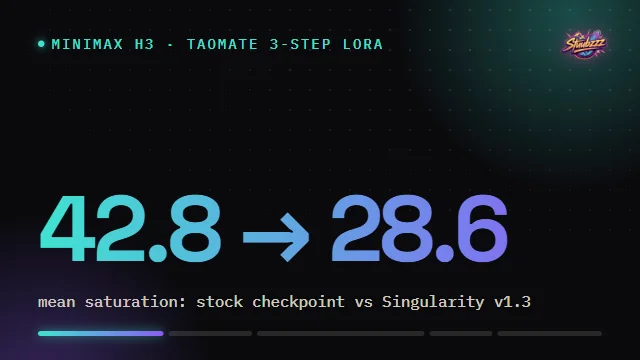
A separate eight-clip test (reference-to-video, 1280x720, 10.125 s, seed 20260918) points the same way. On three setups, at 3 or 4 steps, I switched res_multistep to euler and added a sigma shift of 12.0 for video and 3.0 for audio. Two healthy setups moved by less than 3 points of mean saturation: 47.2 to 46.7 on one and 42.8 to 45.5 on the other. The one setup that was already broken, a 3-step speed LoRA stacked on a merged checkpoint, stayed broken (28.6 to 25.5). I changed two things at once and ran each setup once, so treat it as a sighting. The full numbers are in the LoRA and checkpoint pairing test.
What I would set
- Start from the sampler, scheduler and step count the workflow ships with. All five defaults rendered without a gross failure.
- If you change them on a few-step H3 setup, stay with
euler/simple,euler/betaorer_sde/beta. - Keep
res_multisteponsimple. Do not pair it withbeta. - Leave
dpmpp_2m_sde/karrasalone at 6 to 14 steps. - Judge the result at full size, on playback. Contact sheets catch noise and colour blow-outs and little else.
What the sampler and the scheduler each do inside the KSampler is covered in Part 1 of ComfyUI From Zero, the free part.
Test setup and limits
- One shot (a 5-second alley fight), one seed, one prompt, one machine.
- Six settings per workflow: the shipped default plus the five pairs. That is 29 renders, because EZ's default already is
euler/simple. Seed Hunter's default iser_sde/betatoo, so that pair ran twice there and gave the same clip. The step count stayed at each workflow's default, so the pairs were never compared at a common count. - I changed the prompt, seed, resolution and duration. Seed Hunter's megapixels went from 0.4 to 0.98 to reach the common size, and the first of its three seed previews is the clip I looked at. Multishot ran without its LLM prompt rewriter so the prompt stayed identical.
- Where I lacked an exact model file I used another quantisation of the same model, and for Ultra Fastest an int8 file from the same finetune family.
- One gap I cannot close: the turbo LoRA files named in the Seed Hunter and EZ graphs are not on my disk today, and my notes record no substitute. Both graphs load that LoRA through rgthree's Power Lora Loader, which skips a file it cannot find and carries on. So those two workflows may have run their 6 and 8 steps without a turbo LoRA. The log from that day has rotated out, and I cannot confirm it either way.
Sources and files
- I Blind Ranked the Top MiniMax H3 Workflows on Civitai: the video this post belongs to. The sampler round runs from 1:47 to 4:14.
- The five workflows, all published on Civitai, with thanks to their authors: PlagueKind H3 by Plaguekind (sparse attention, the shortest run times in this round), Seed Hunter by foxydits (three seed previews, then an upscale of the one you pick), EZ by mrweaz (turbo render with a latent upscale pass and an optional LTX 2.5 refine), Ultra Fastest by RedditUser9811 (8-step turbo render with RTX Video Super Resolution x2) and Multishot by joeygambino (multi-shot scenes as one continuous take).
- ComfyUI, comfy/samplers.py: the stock sampler and scheduler list and how each scheduler builds its sigmas.
- ClownsharkBatwing/RES4LYF: the node pack that registers
beta57. - ComfyUI docs: MiniMax H3 native workflows and the MiniMaxAI/MiniMax-H3 model card.
- stuubszzz/Stubelius-Ultimate-H3: my own free H3 workflow. It was not part of this test.
- On this site: the LoRA and checkpoint pairing test and the LTX 2.5 sampler settings post: euler_ancestral, res_2s and when the distilled LoRA is needed.
Common questions
What is the best sampler for MiniMax H3?
I cannot name one from this test. euler/simple, euler/beta and er_sde/beta rendered without a gross failure on all five workflows at 6 to 14 steps, on one shot, one seed and one RTX 5090, and I have not ranked them at full size. Start from the workflow's shipped default and stay inside those three if you change it.
Is beta57 a built-in ComfyUI scheduler?
No. Stock ComfyUI has beta, which uses alpha 0.6 and beta 0.6. beta57 is registered by the RES4LYF node pack as the same schedule with alpha 0.5 and beta 0.7. Multishot v2.7 ships with it and PlagueKind H3 V9 stores it as beta_57, so a graph that asks for it needs a node pack that provides the name.
Do dpmpp_2m_sde/karras and res_multistep/beta recover at 20 steps?
I do not know. Every run here used 6 to 14 steps on one RTX 5090 (32 GB), and I did not render a 20-step control or test another card. The failures are documented for few-step setups only.